Research Notes: Grey-headed Flying Fox, Sydney (’Sydney Is Hiding 35,000 Bats’)
This page documents the sources behind factual claims made in this video. It’s not the most thrilling read I have to say. The purpose is to purely provide my sources. It does contain some extra information which didn’t make it into the final cut. So keep an eye out for bonus facts! What excitement!
The flying-fox colony is located in Lachlan Swamp in Centennial Park, Sydney
Source
Ecosure (2025), Centennial Park Flying-Fox Camp Management Plan
https://www.centennialparklands.com.au/getattachment/About-us/Parklands-Projects/Flying-fox-Camp-Management-Plan/FINAL-Centennial-Park-GHFF-CMP-2025.pdf.aspx?lang=en-AU
Quote from Source
"The camp is located in an area of Centennial Park referred to as Lachlan Swamp, surrounded by vegetation."
Grey-headed flying foxes are a species of megabat
Source
DCCEEW Species Profile and Threats Database, Pteropus poliocephalus — Grey-headed Flying-fox
Adult grey-headed flying foxes have a wingspan of one metre.
Source
NSW Department of Climate Change, Energy, the Environment and Water (2024), Flying-foxes, NSW Environment & Heritage
https://www.environment.nsw.gov.au/topics/animals-and-plants/native-animals/native-animal-facts/land-mammals/flying-foxes
Quote from Source
"Adults have an average wingspan up to one metre and can weigh up to one kilogram."
Bonus Fact!
The grey-headed flying fox is not the largest bat in the world by wingspan. That distinction belongs to the giant golden-crowned flying fox (Acerodon jubatus) of the Philippines, which can reach a wingspan of 1.7 metres.
Source
Giant golden-crowned flying fox (Acerodon jubatus), Wikipedia
https://en.wikipedia.org/wiki/Giant_golden-crowned_flying_fox
Quote from Source
The giant golden-crowned flying fox is one of the largest bat species in the world. It is among the heaviest of all bat species, with individuals weighing up to 1.40 kg. The only bat species known to weigh more than the giant golden-crowned flying fox are the Indian flying fox (Pteropus medius) and great flying fox (Pteropus neohibernicus), with a maximum weight of 1.6 kg and 1.45 kg respectively. It has the longest forearm length of any species, measuring up to 215 mm. The great flying fox has a slightly shorter forearm length, and its wingspan is thus presumed to be lesser as well. The wingspan of the Indian flying fox is up to 1.5 m, while the giant golden-crowned flying fox has a wingspan of 1.5–1.7 m.
Black flying foxes are also present at the Centennial Park camp.
Source
Ecosure (2025), Centennial Park Flying-Fox Camp Management Plan
https://www.centennialparklands.com.au/getattachment/About-us/Parklands-Projects/Flying-fox-Camp-Management-Plan/FINAL-Centennial-Park-GHFF-CMP-2025.pdf.aspx?lang=en-AU
Quote from Source
"Small numbers of BFF are usually present (typically ~300)."
Black flying foxes are generally found in the coastal areas of northern Australia, but their range has been shifting southward in recent decades, bringing them into grey-headed flying fox territory.
Source
Ecosure (2025), Centennial Park Flying-Fox Camp Management Plan
https://www.centennialparklands.com.au/getattachment/About-us/Parklands-Projects/Flying-fox-Camp-Management-Plan/FINAL-Centennial-Park-GHFF-CMP-2025.pdf.aspx?lang=en-AU
Quote from Source
"BFF have spread further south over recent decades."
During mating season, male grey-headed flying foxes establish small territories along tree branches, which they defend aggressively. They mark their territories using scent secreted from glands on their neck and shoulders. Females actively choose a mate by moving into a male's territory.
Source
Sydney Bats
https://sydneybats.org.au/flying-foxes/gray-headed-flying-fox/grey-headed-flying-fox-reproduction/
Quote from Source
"From January each mature male marks his territory in a tree with secretions from scent gland on his shoulders. He defends it vigorously from other males with wing-spreading threat displays and loud calls. Females chose a male, and may stay with him for weeks or only a few days."
When the colony flies out at dusk, dominant harem-holding males are the last to leave - they remain behind to guard their territories and the females roosting within them until all have departed.
Source: Welbergen, J.A. (2006). Timing of the evening emergence from day roosts of the grey-headed flying fox, Pteropus poliocephalus: the effects of predation risk, foraging needs, and social context. Behavioral Ecology and Sociobiology, 60, 311–322. https://doi.org/10.1007/s00265-006-0167-3
Quote from Source
"Smaller bachelor males emerged from the colony earlier than larger harem-holding males who guard their harems until the last female had left."
Males can lose more than 20% of their body mass during the mating season.
Source
Welbergen, J.A. (2011). Fit females and fat polygynous males: seasonal body mass changes in the grey-headed flying fox. Journal of Animal Ecology. PubMed ID: 21153744.
Quote from Source
"Males accumulated body reserves prior to the breeding season, but subsequently lost over 20% of their body mass on territory defence and courtship."
Bonus Fact!
Most grey-headed flying fox camps are found in urban areas, and - surprisingly - the density of camps is higher where human population density is higher.
Source
Ecosure (2025). Centennial Park Flying-Fox Camp Management Plan.
https://www.centennialparklands.com.au/getattachment/About-us/Parklands-Projects/Flying-fox-Camp-Management-Plan/FINAL-Centennial-Park-GHFF-CMP-2025.pdf.aspx?lang=en-AU
Quote from Source
"Of the 310 GHFF camps identified, 59% were in urban land use... higher densities of camps occurred in areas with greater human population densities."
Grey-headed flying foxes are nomadic.
Source
NSW Environment & Heritage, Flying Foxes
https://www.environment.nsw.gov.au/topics/animals-and-plants/native-animals/native-animal-facts/land-mammals/flying-foxes
Quote from Source
“Flying-foxes are nomadic mammals that travel across large areas of Australia, feeding on native blossoms and fruits, spreading seeds and pollinating native plants.”
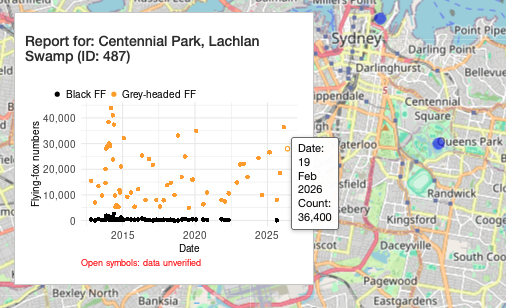
The colony holds tens of thousands of bats. Numbers vary.
Source
Ecosure (2025). Centennial Park Flying-Fox Camp Management Plan.
https://www.centennialparklands.com.au/getattachment/About-us/Parklands-Projects/Flying-fox-Camp-Management-Plan/FINAL-Centennial-Park-GHFF-CMP-2025.pdf.aspx?lang=en-AU
"The average population recorded during quarterly counts is ~15,000 GHFF but varies seasonally and annually."
In 2020, the camp was estimated to hold 95,000 bats.
Source
Ecosure (2025). Centennial Park Flying-Fox Camp Management Plan.
https://www.centennialparklands.com.au/getattachment/About-us/Parklands-Projects/Flying-fox-Camp-Management-Plan/FINAL-Centennial-Park-GHFF-CMP-2025.pdf.aspx?lang=en-AU
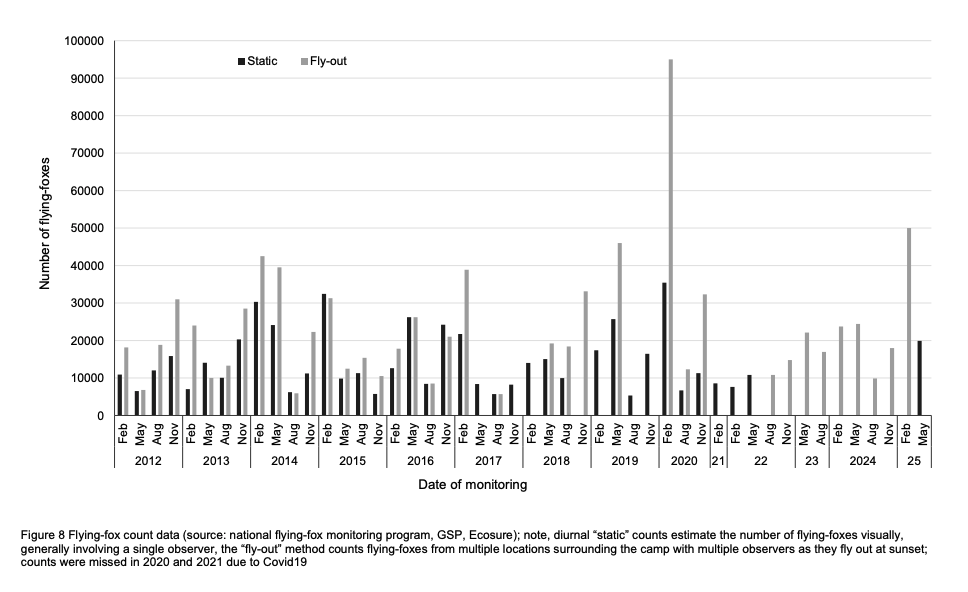
95,000 is approximately a fifth of the entire national population of grey-headed flying foxes.
Source
IUCN Red List; P., Roberts, B., Pennay, M. & Welbergen, J.A. 2021. Pteropus poliocephalus. The IUCN Red List of Threatened Species 2021: e.T18751A22085511
https://www.iucnredlist.org/species/18751/22085511
Quote from Source
“Number of mature individuals 467,000”
The most recent camp population estimate was 35,000 in February 2026.
Unfortunately I said 2025 in the video which was incorrect!
Source
The Australian Fly-fox Monitor; Animal Ecology Lab
https://animalecologylab.shinyapps.io/australianflyingfoxmonitor/
Grey-headed flying foxes mostly eat nectar, pollen and fruit. Grey-headed flying foxes have been recorded feeding on 187 different plant species.
Source
Williams, N.S.G., McDonnell, M.J., Phelan, G.K., Keim, L.D. & van der Ree, R. (2006). Range expansion due to urbanization: Increased food resources attract Grey-headed Flying-foxes (Pteropus poliocephalus) to Melbourne. Austral Ecology, 31, 190–198. https://doi.org/10.1111/j.1442-9993.2006.01590.x
Quote from Source
"Fruit, flowers, pollen, nectar and in rare cases leaves, of 187 plant species from 50 taxonomic families have been previously recorded as food for P. poliocephalus."
Grey-headed flying foxes can travel 50 kilometres in a night to feed.
Source
NSW Department of Climate Change, Energy, the Environment and Water (2024). Flying-foxes. NSW Environment & Heritage.
Quote from Source
"Flying-foxes can travel up to 50 km from their camps to feed at night."
Grey-headed flying foxes can fly at 60 km/hr.
Source
Sydney Bats
https://sydneybats.org.au/flying-foxes/gray-headed-flying-fox/
Quote from Source
Flying-foxes can use tail winds to move at speeds up to 60km per hour
Grey-headed flying foxes can travel up to 300 kilometres in a single night when moving between camps.
Source
Ecosure (2025), Centennial Park Flying-Fox Camp Management Plan
https://www.centennialparklands.com.au/getattachment/About-us/Parklands-Projects/Flying-fox-Camp-Management-Plan/FINAL-Centennial-Park-GHFF-CMP-2025.pdf.aspx?lang=en-AU
Quote from Source
"can travel up to 300 km between roosts in a single night."
A single grey-headed flying fox can disperse up to 60,000 seeds in a single night across a 50-kilometre stretch of land.
Source
Wildlife Queensland (2023), Flying-foxes: Guardians of biodiversity
https://wildlife.org.au/flying-foxes-guardians-of-biodiversity/
Quote from Source
"Each flying-fox can spread up to 60,000 seeds across a 50-kilometre stretch of land in one night."
The Centennial Park flying-fox camp is actively managed to protect the colony and the ecosystem services it provides.
Source
Ecosure (2025), Centennial Park Flying-Fox Camp Management Plan
https://www.centennialparklands.com.au/getattachment/About-us/Parklands-Projects/Flying-fox-Camp-Management-Plan/FINAL-Centennial-Park-GHFF-CMP-2025.pdf.aspx?lang=en-AU
Quote from Source
"Protect and maintain the Centennial Park flying-fox camp."
The grey-headed flying fox is listed as vulnerable to extinction and the population is decreasing.
Source
IUCN Red List; P., Roberts, B., Pennay, M. & Welbergen, J.A. 2021. Pteropus poliocephalus. The IUCN Red List of Threatened Species 2021: e.T18751A22085511
https://www.iucnredlist.org/species/18751/22085511
The primary cause of population decline is the clearing of native vegetation, which removes roosting and breeding habitat and reduces food availability.
Source: Ecosure (2025). Centennial Park Flying-Fox Camp Management Plan. https://www.centennialparklands.com.au/getattachment/About-us/Parklands-Projects/Flying-fox-Camp-Management-Plan/FINAL-Centennial-Park-GHFF-CMP-2025.pdf.aspx?lang=en-AU
Quote from Source
"The main threat to flying-foxes in NSW is clearing native vegetation. This threatening process removes roosting and breeding habitat and limits the availability of natural food resources."
Extreme heat poses a severe and growing threat. Temperatures above 42°C can kill flying foxes at scale.
Source
Petra Stock, Flying foxes die in their thousands in worst mass-mortality event since Australia’s black summer, The Guardian, 12/01/2026
Quotes from Source
“Temperatures over 42 degrees are known to cause mortality in flying foxes, sometimes at biblical scales,” said Prof Justin Welbergen, an expert in flying foxes at Western Sydney University.”
“above 42C, dehydration and heat stroke made it “physiologically very difficult for animals to survive”.
In the summer of 2019–20, an estimated 72,000 flying foxes died from heat stress.
Source
Ecosure (2025), Centennial Park Flying-Fox Camp Management Plan, citing Mo et al. (2021).
Quote from Source
"In 2019–20 summer alone, an estimated 72,000 flying-foxes perished in 40 camps across Victoria, NSW, Australian Capital Territory, and South Australia."
As the planet warms
Literally so many sources I am not even going to start with this one.
Black flying foxes — which are not currently listed as threatened — are expanding their range southward, bringing them into increasing competition with grey-headed flying foxes and adding further pressure on the species.
Source (not listed as threatened)
IUCN Red List, Roberts, B., Eby, P., Tsang, S.M. & Sheherazade. 2017. Pteropus alecto. The IUCN Red List of Threatened Species 2017: e.T18715A22080057.
https://www.iucnredlist.org/species/18715/22080057
Source (range expanding southward): Ecosure (2025), Centennial Park Flying-Fox Camp Management Plan
https://www.centennialparklands.com.au/getattachment/About-us/Parklands-Projects/Flying-fox-Camp-Management-Plan/FINAL-Centennial-Park-GHFF-CMP-2025.pdf.aspx?lang=en-AU
Quote from Source
"BFF have spread further south over recent decades."
